THE PAVILION
NO NEED TO SPARKLE
Experiments in Love and Revolution
We feel a fracturing of reality in the air; a chasm in the sky. Global powers are realigning, populations are in flux, temperatures are rising. Our search for the truth − or the multiple truths that exist around us − is manipulated by powers hungry for gain. We juggle continuous news streams and shifting world orders, a proliferation of voices that leave us cynical and unable to act.
No Need To Sparkle: Experiments in Love and Revolution is conceived as a space that allows truth to reposition itself in the world, and that introduces uncertainty and ‘doubt’, not as a capitulation, but as a path to understanding the world with openness and empathy.
Our title is borrowed from Virginia Woolf’s essay, A Room of One’s Own; ‘No need to hurry. No need to sparkle. No need to be anybody but oneself’. In the context of our pavilion, we understand ‘sparkle’ as a metaphor for ideological certainty and performative positioning on a global stage. We call for empathy rather than certainty, and we acknowledge that multiple voices and viewpoints can exist in the world contemporaneously.
Adrian MM Abela, Charlie Cauchi and Raphael Vella have created separate screen-based works, which nonetheless betray their shared preoccupations with authenticity, post-colonial self-determination, and myth-making.
Each artist parses our fictional and actual presents, anchoring their work in manifold pasts and imaginable futures. Each draws from varied sources including archival material, cinema, popular culture, and historic and spiritual texts. In doing so they travel across mythologies, histories, and cinematic illusion and eventually arrive at a form of personal resistance.
The works within the pavilion seek to deceive; they hide, misdirect and beautifully obfuscate. Moving-image holds the ability to liquefy time and space, and solid sculpture brings its own dissimulations to the table. Our sense of reality is diminished, and we, in being fooled, risk acquiring humility.
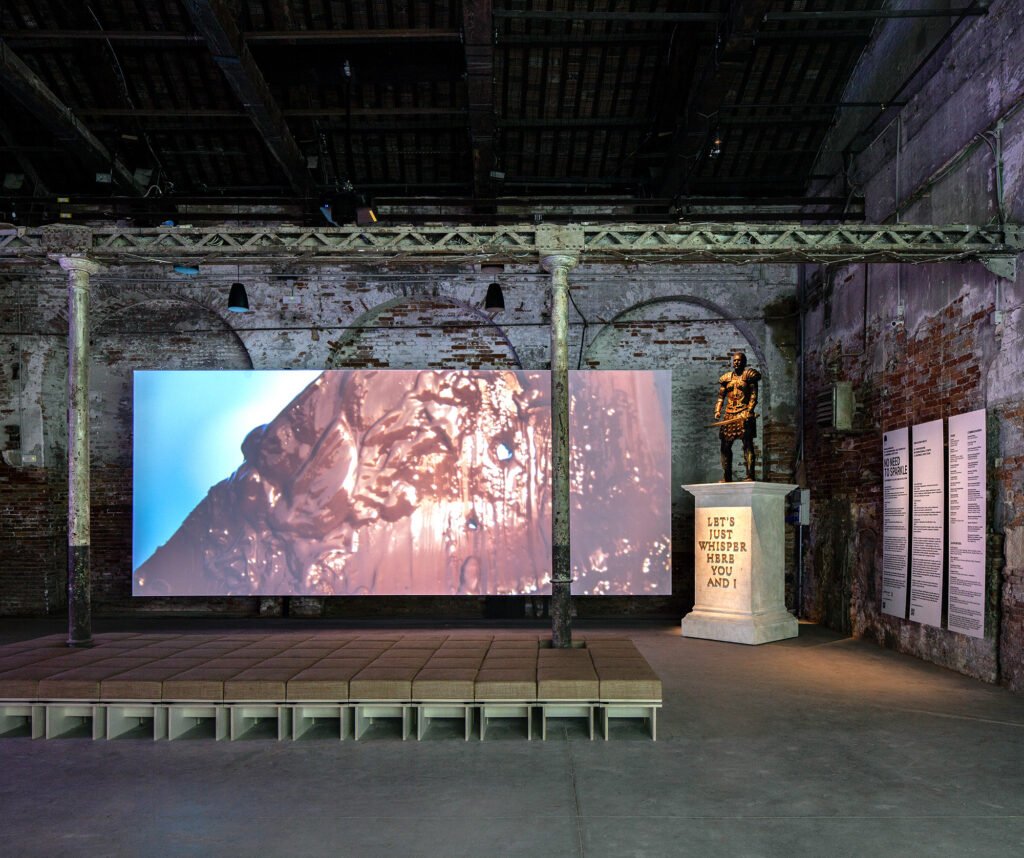
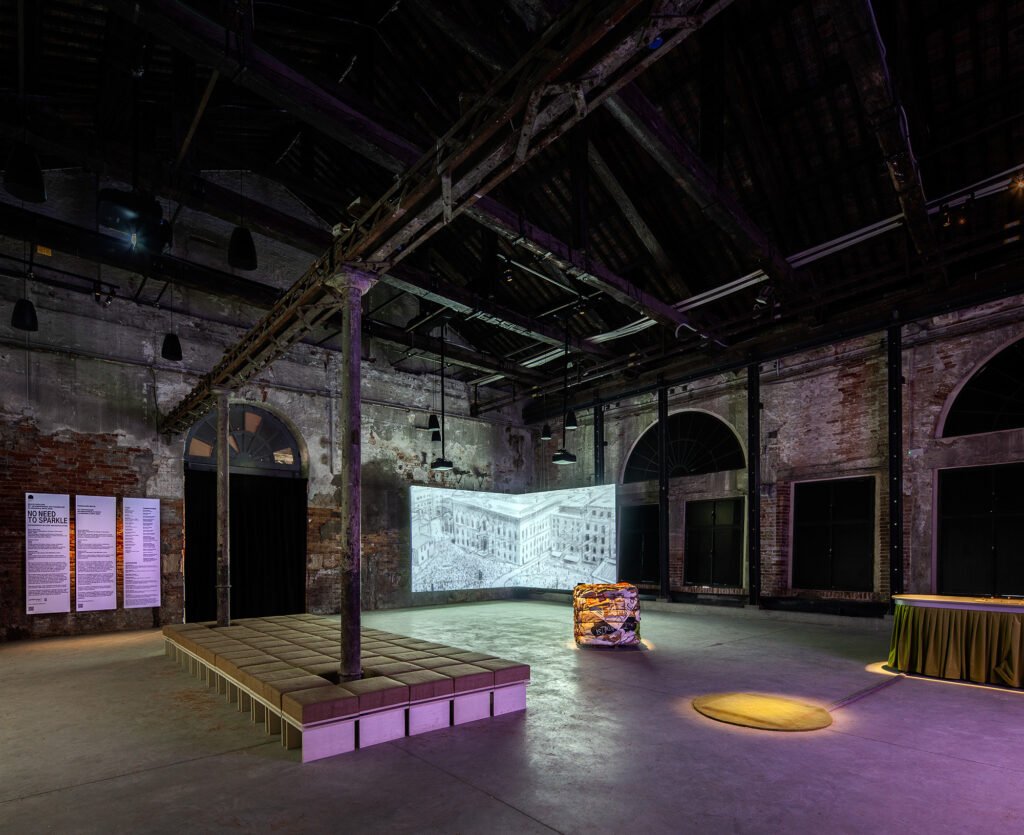
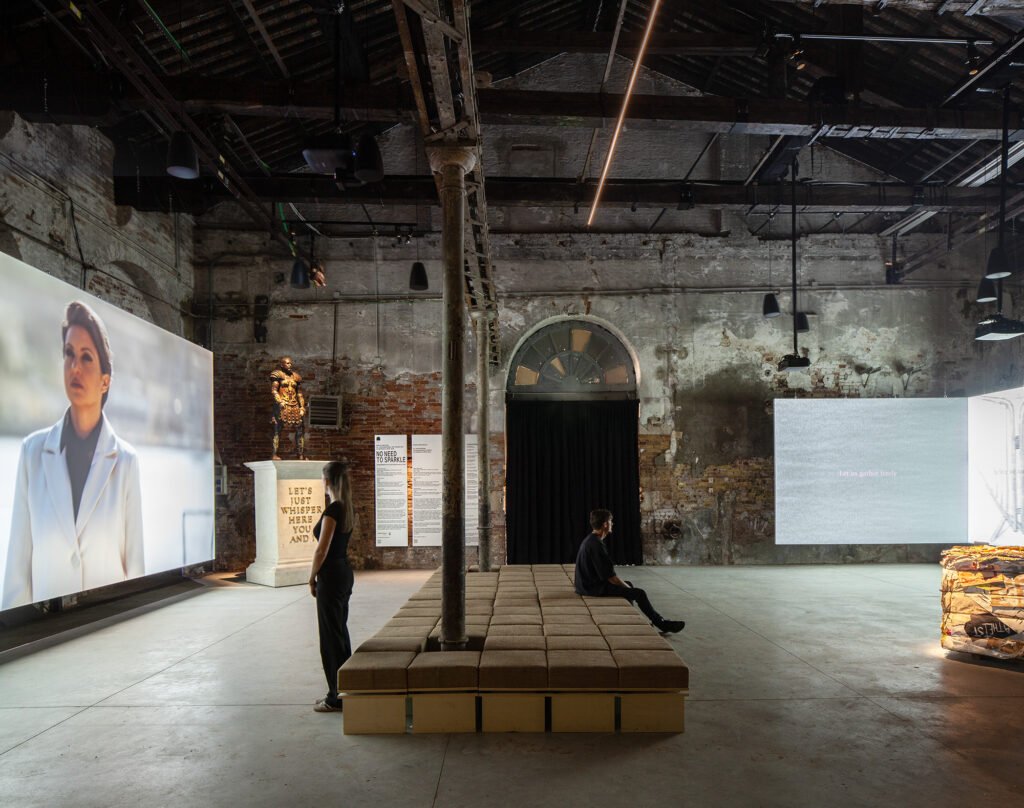
Placed centrally, and at a point where the three works’ orbits overlap is an invitation to pause and sit within the space. This invitation, that is at once physical and metaphorical, acts as a prompt for contemplation and allows us to sit together in the spirit of an agora, with openness and inquiry. Certainty can give way to doubt, making room for a world that hosts thoughtfulness, curiosity and collective empathy.
And as we engage in this space with moments of catharsis and crises of authenticity, we challenge triumphal notions of nation-founding and power, but we are not cynical in this endeavour. Meaning dissolves, truth repositions itself, and time revolves and resolves, but hope always pulses and crackles at dawn.
No Need To Sparkle therefore proposes doubt and doubting not as paralysis, but as a vital act of resistance.
Adrian MM Abela
Declaration of Dependence
(A Game of Surrender)
2023 – 2026
Stage; curtain/veil; stage lights; found coins; magnets; computer; game engine; divinatory software; built world; built figure; sound; pressure sensor; motors; fabricated coins; dance algorithm; framed drawing; seven hidden drawings (pen; hidden folder; hidden promise device (copper plated bronze); performance; game of chance; custodian interaction; website: declarationofdependence.com
Average duration: ~3:00
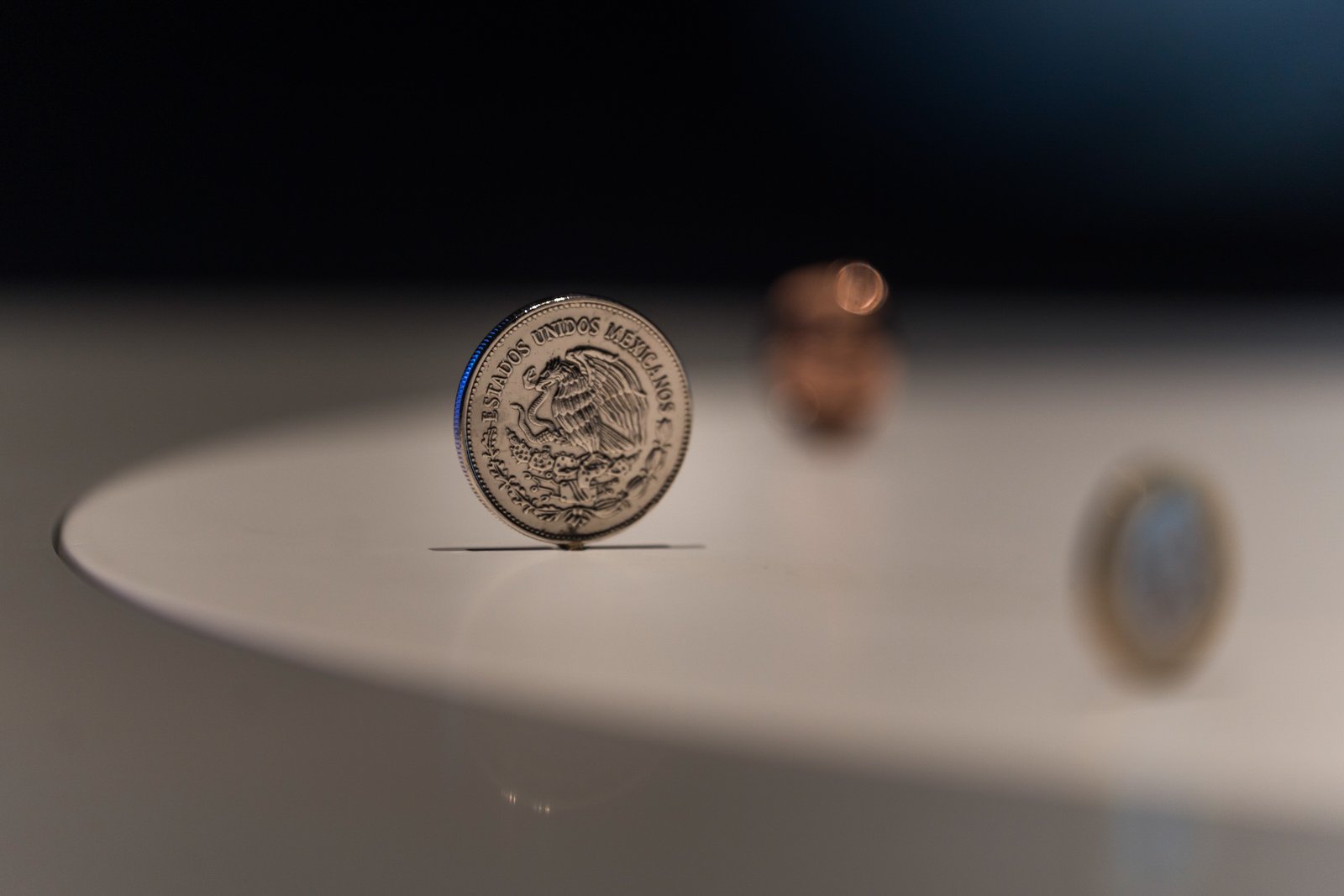
Photo: Samuele Cherubini
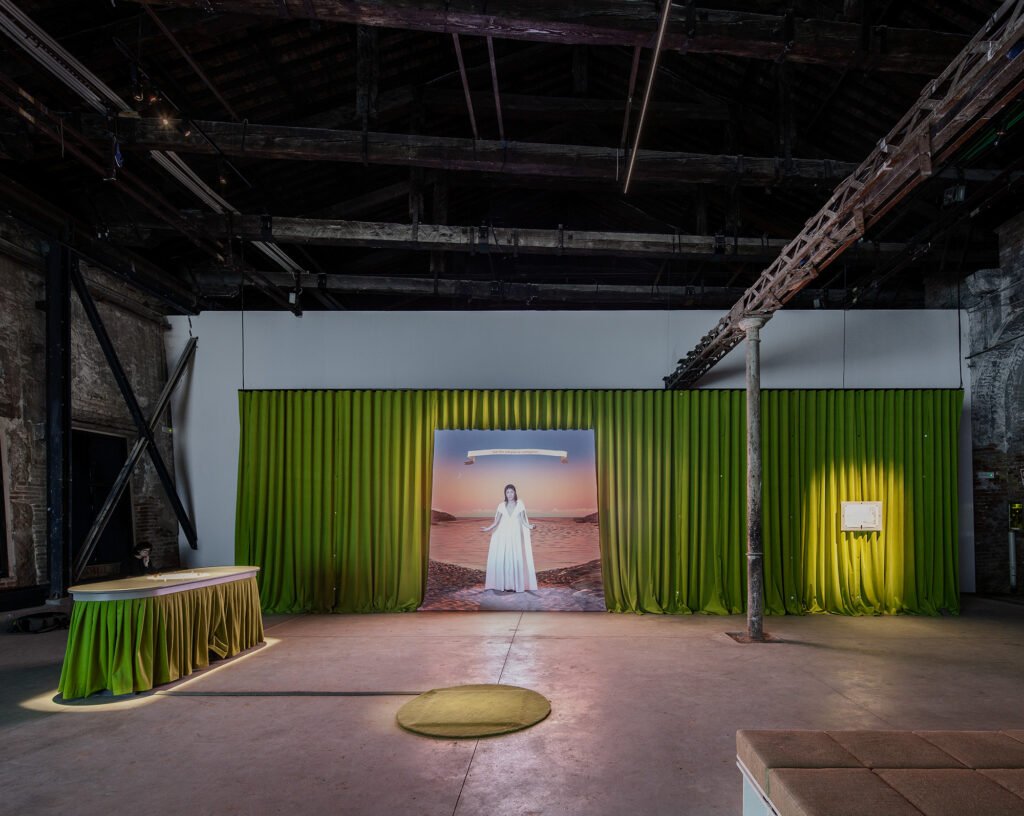
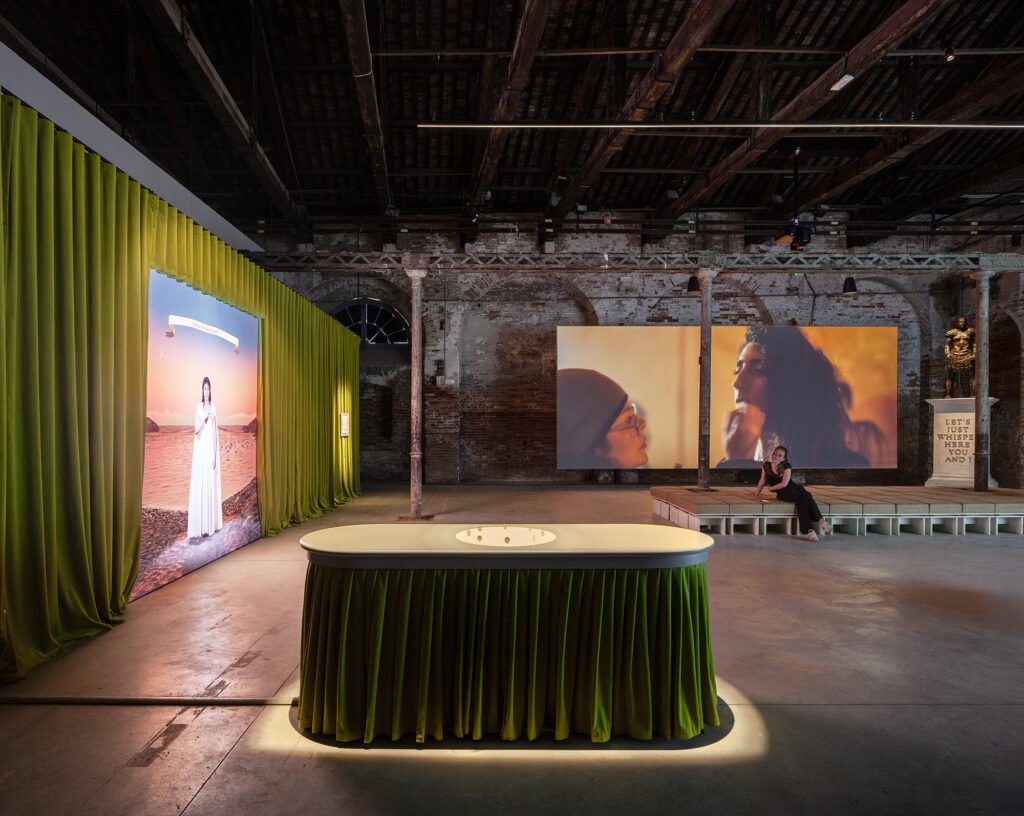
Declaration of Dependence unfolds as a stage divided into three temporal zones. To the left, eight coins spin on a table representing the future suspended in a moment of unresolved possibility, neither heads nor tails, not yet determined. To the right, an illustrative drawing depicts the past, presented as fixed and legible, a record of what has already been written into being, although not necessarily determined, as the viewer reads it through their own interpretation and through what they have previously experienced. At the curtained centre, the personification of Malta, Melita, exists within a game engine, occupying the present as a living, responsive presence.
Each time a visitor steps onto the rug, Melita delivers a unique declaration, assembling an experience specific to that visitor: an act of divination selected by chance for that moment, and rendered in real-time within a game-engine.
Declaration of Dependence includes additional veiled works, accessible only through interaction with the custodian, while further aspects of the work circulate through word of mouth. The veiled works are fractal poems that emerge from the central theme as stories or narratives, proposing further perspectives through which to study or explore the subject of the Self, and what that means in relation to identity as we understand it today. Each poem opens onto another, scaling inward and outward, refusing closure. The art, in this sense, lies in the interaction with another, not in the produced materials, which serve only as the conditions under which that interaction can take place.
This deliberate layering creates a structure in which the totality of the piece can never be fully apprehended by any single viewer; what is seen is only what is offered; what is offered depends on who asks, and how. The work, in this sense, mirrors the conditions of identity itself: partial, relational, and never wholly present to itself.
To declare dependence is to refuse the fiction of the sovereign self. It is to acknowledge that nationhood, identity, and even artistic authorship are constituted through relations that exceed the individual. Declaration of Dependence invites the visitor not to receive a statement, but to participate in its making.
The work in its current form also questions whether art should be shown in such a format at all. This approach was taken within an ethical framework, and is expressed in the verbal aspects of the presentation, where what is said around the work carries as much weight as what is shown (or not).
The choice to continue the work Declaration of Dependence, first shown in 2023, came from the context of a curated environment alongside other artists from the same place, exploring the same overarching subjects. Beyond this shared geography, the notion of nationhood within the current system may need to be rethought, particularly at such a historic biennale, and in a time marked by the absence of global peace and stability.
Moving Image
Production: falsework studio – Matthew Doyle & Yuehao Jiang
Model & Performer: Aslan Scardina
Voice & Melody: Cher Camilleri
Technical Director: Cecil Boey
Senior Technical Artist: Tyler “vonpixel” Muehlen
Technical Artist: Jovanni Mixco
Interaction Designer: Jonathan Moore
Project Manager: Andy Li
Photography & MoCap Lighting: Brandon Kelly
Sculptural Elements
Engineering & programming: Julian Stein
Carpentry: DAMS Design and Manufacturing Studio
Communications
Graphic Design: Theo Cachia
Website: Alice Yuan Zhang
Special Thanks
Rachel Ho
Yasmin Kuymizakis
Thanks to
Jennifer Abela, Paul Abela, Alice Yuan Zhang, Anton Grech, Nigel Baldacchino, Aaron Abela, Bertu Falzon, Eric Vrymoed, Nevada Hardman, Alexandra Aquilina, friends in Malta and Los Angeles for their time and perspectives, Charles Gaines Studio, and the Tarot and the I-Ching
Charlie Cauchi
Dolce
2026
Single‑channel 4K video, colour, sound, sculptural installation (chocolate and mixed materials)
Incorporated chocolate sculpture originally created by Tiziano Cassar for the Ħamrun Chocolate Festival
Duration: 22:56
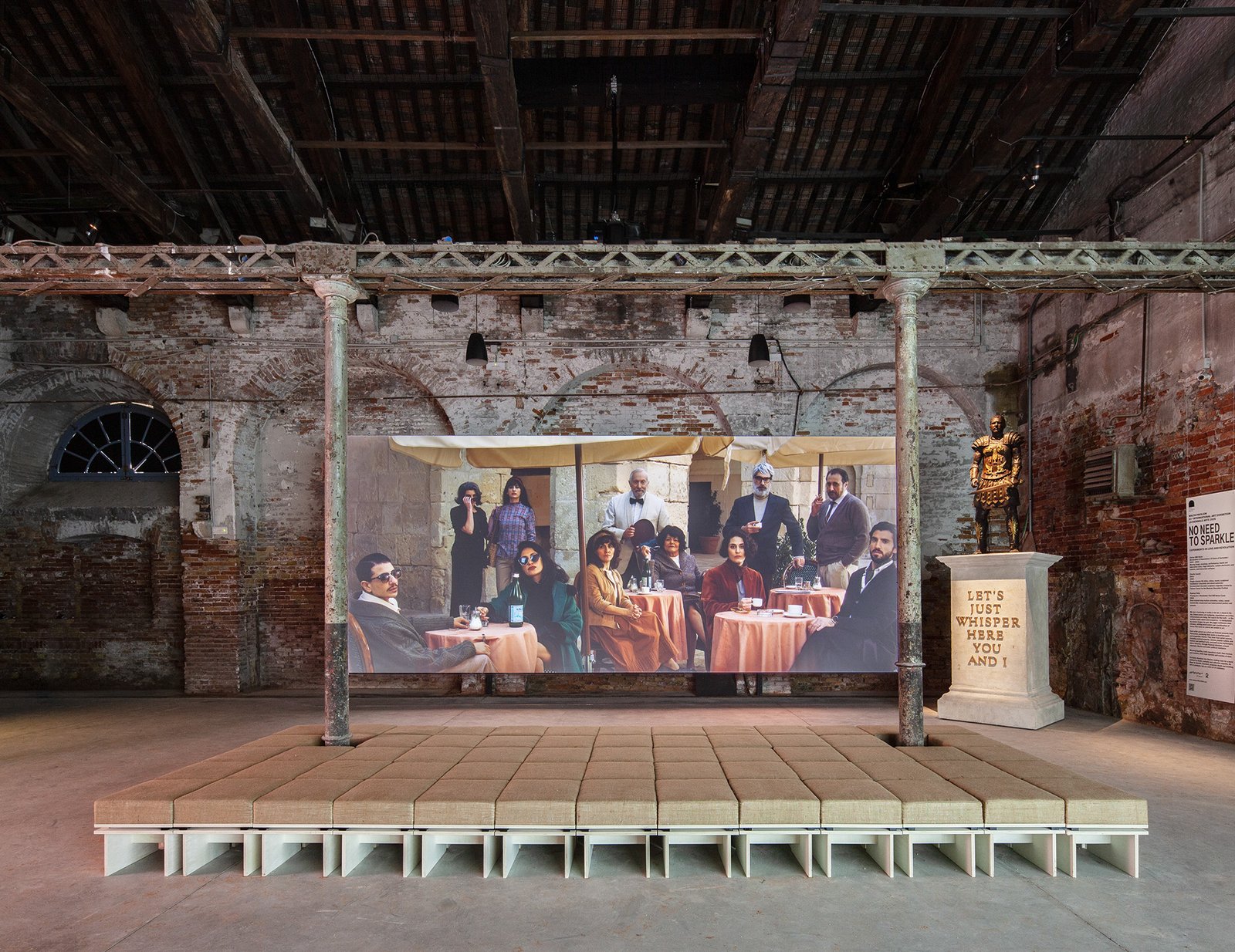
Photo: Julian Vassallo
Dolce explores the complex relationship between reality and mediation, approaching Malta and its people as a palimpsest in which histories accumulate rather than disappear. The work embraces the island’s ancient heritage and colonial past while remaining attentive to a present that is, at times, eclipsed or reconfigured by contemporary culture, accelerated development, and evolving media forms. It builds both on and against many films that have been made and are continually made in Malta, productions enabled by its history, geography, and cinematic pliability, yet often indifferent to local narratives.
From antiquity to colonial rule, from Christianity and popular culture to mass media and new technologies, Dolce reveals Malta as a layered site where memory, identity, and representation are continually rewritten. The artist draws upon an extensive archive of films and images in which Malta does not so much appear as itself as it is subsumed within the demands of international modes of production, serving as a cinematic “other,” a backdrop onto which external narratives are projected.
An important reference point is La Dolce Vita, particularly Rome’s transformation into “Hollywood on the Tiber,” where American studios produced financially successful films by constructing their own image of the city as a cinematic subject. Like Fellini, the artist works from an acute awareness of how place is mediated and mythologised through cinema. In Dolce, Malta’s image, which is shaped, captured, and othered by others, becomes a site of resistance. Moments of defiance emerge when background actors within the cinematic apparatus break the fourth wall, looking directly at the audience and reclaiming the gaze. The artist places herself within the frame: her most explicit act of resistance and reframing is the simple gesture of opening her eyes, refusing to play dead.
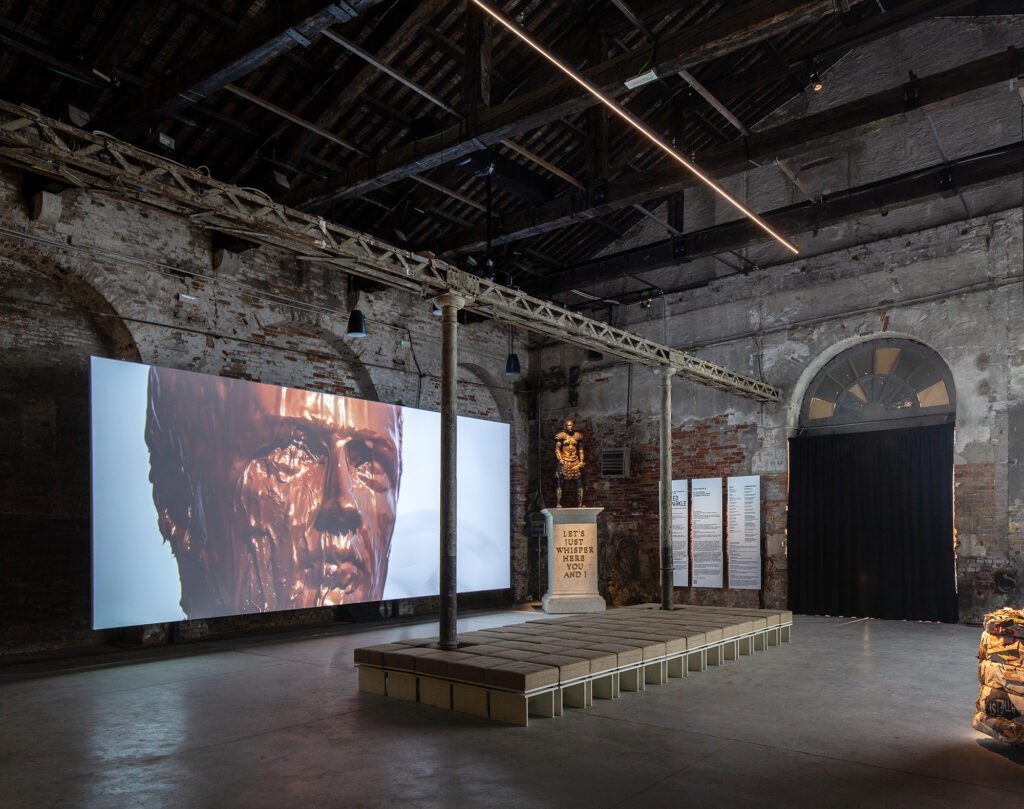
This act of defiance is echoed in the film’s incorporation of a Russell Crowe statue, this time rendered in chocolate, a comic and surreal reworking of the statue of Christ in La Dolce Vita. In Fellini’s film, the helicopter-borne Christ figure, destined for the Vatican and followed by journalists and paparazzi, was deemed scandalous, emblematic of the Church’s entanglement with spectacle and publicity. In Dolce, Christ is replaced by a gladiatorial figure: a replica of a chocolate statue of Russell Crowe as Maximus, originally made for the Ħamrun Chocolate Festival during the filming of Gladiator 2 in Malta and publicly endorsed by Crowe himself. The statue, exposed to the elements of Venice has, since its installation in May 2026, morphed and changed. What appears on screen is thus reflected over the course of the Venice Biennale; film playing life playing film.
Rather than travelling towards the Vatican, the statue’s flight traces a different route: it passes over the purpose-built set constructed by Ridley Scott and heads towards the site of the annual film festival. Where Fellini’s Christ figure signalled institutional investment in spectacle, Dolce reflects on contemporary investments in visibility, publicity, and global production, often at the expense of local complexity.
The film oscillates between moments of glamour, labour, and boredom, collapsing distinctions between the authentic and the performative. This tension is heightened through the casting of non-professional participants alongside actors, and by revealing the mechanisms and downtime of filmmaking itself. Boredom, loneliness, and isolation punctuate the narrative. In a dream sequence, the statue melts, an image that gestures towards death and loss, but also renewal and resurrection. Time collapses; what was once solid melts away, leaving open the possibility that meaning, like identity, may yet reform in another state, or simply repeat itself.
Film Work
Cast: Martina Georgina, Antonella Axisa, Mikhail Basmadjan, Zoe Camilleri, Samantha Cassar Ellis, Charlie Cauchi, Josette Ciappara, Paul Cilia, Joanna Delia, Romeo Roxman Gatt, Tiffany Pisani, Tina Rizzo, Gianni Selvaggi, Henry Zammit Cordina
DOP: Julia Mingo
Editor: Céline Perreard
Production designer: Jon Banthorpe
Sound Mix: Yazmin Kuymizakis
Production Manager: Elaine Bonello
Thanks to
Ana Attard, Jimmy Buhagiar, Julia Mingo, Tiziano Cassar, Tiffany Pisani, Mark Portelli, Dr Mark Vassallo, Tasha Galea, Charlton Caruana, Tasha Galea, Godwin Mifsud, Mario Demanuele, Warren Brimmer, John Muscat, Joanna Delia, Ramon Fenech, Armed Forces of Malta, Sarah Chircop, Lisa Attard, Joshua de Giorgio, Patrice Peyre, Sandra Peyre, Samantha Gatt, Romeo Roxman Gatt, Micro Climat Studios.
Raphael Vella
Praying for a Revolution That Will Never Come
2026
Dual-channel stop-motion animation, colour, sound
Duration: 07:16
Industrially compressed and baled protest posters and banners
80cm × 90cm × 105cm
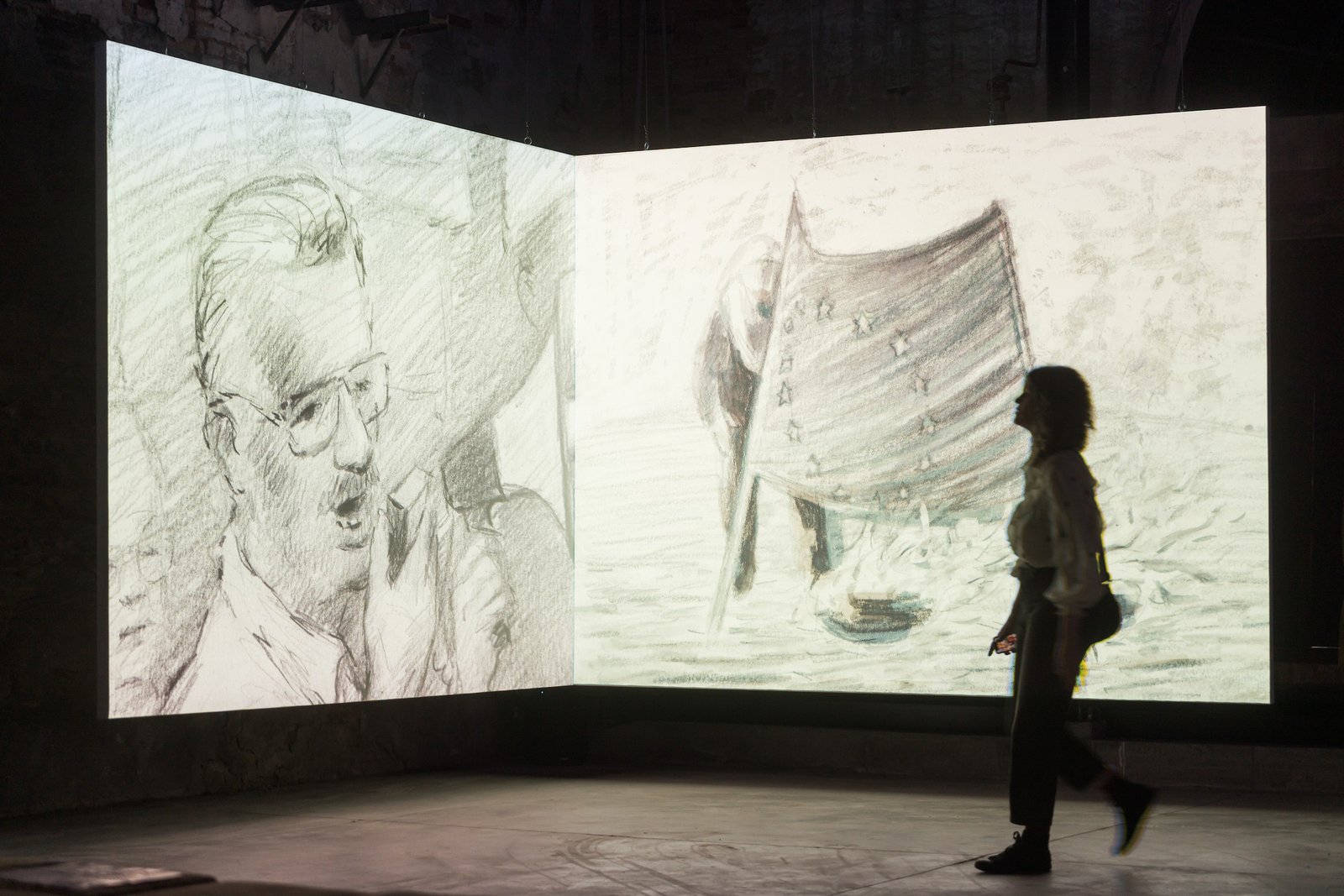
Photo: Samuele Cherubini
The title of Raphael Vella’s Praying for a Revolution That Will Never Come brings together quiet supplication and restless dissent, situating both within a landscape that seems to be moving towards inevitable collapse. Yet this sense of bleakness remains intentionally ambiguous, gesturing instead towards a persistent yearning that endures despite the presence of police barriers.
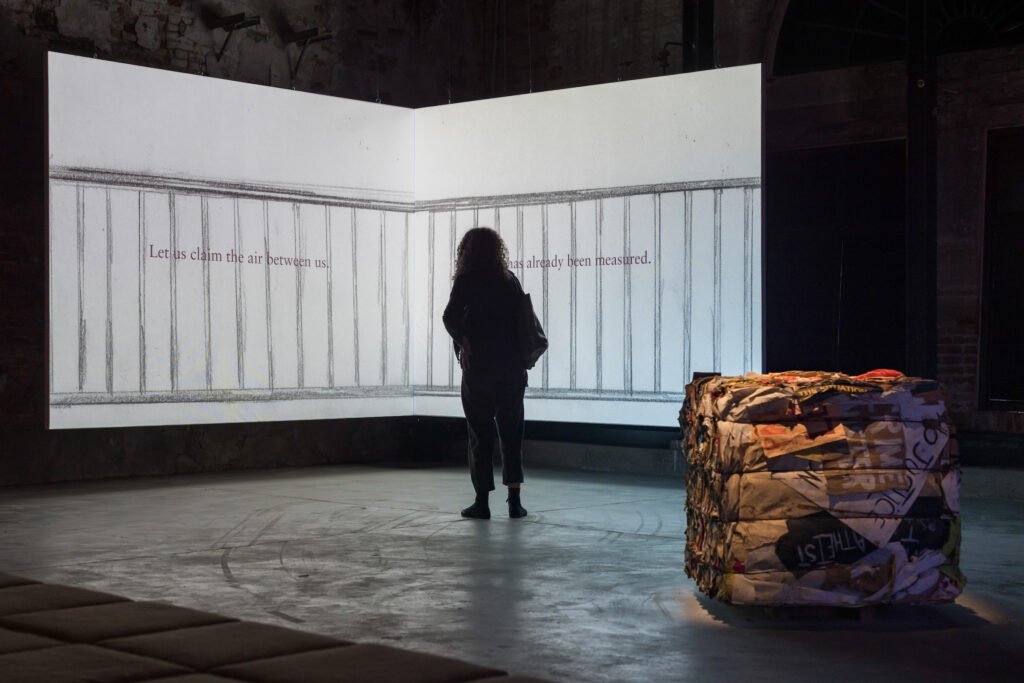
Spanning just over a century of protests and demonstrations in Malta, the hundreds of drawings that make up the work suggest that hope operates within a continuous loop. Horizons worth striving for continue to draw crowds, each giving way to another, but no final horizon ever arrives to end the quest. Sounds shift anxiously between protest noise and songs lifted from archival footage and recordings of a hydraulic machine made in a baler facility. The public is immersed in political choices as flickering sequences move across two corner projections, yet the agitated imagery never lingers long enough on a single slogan or action.
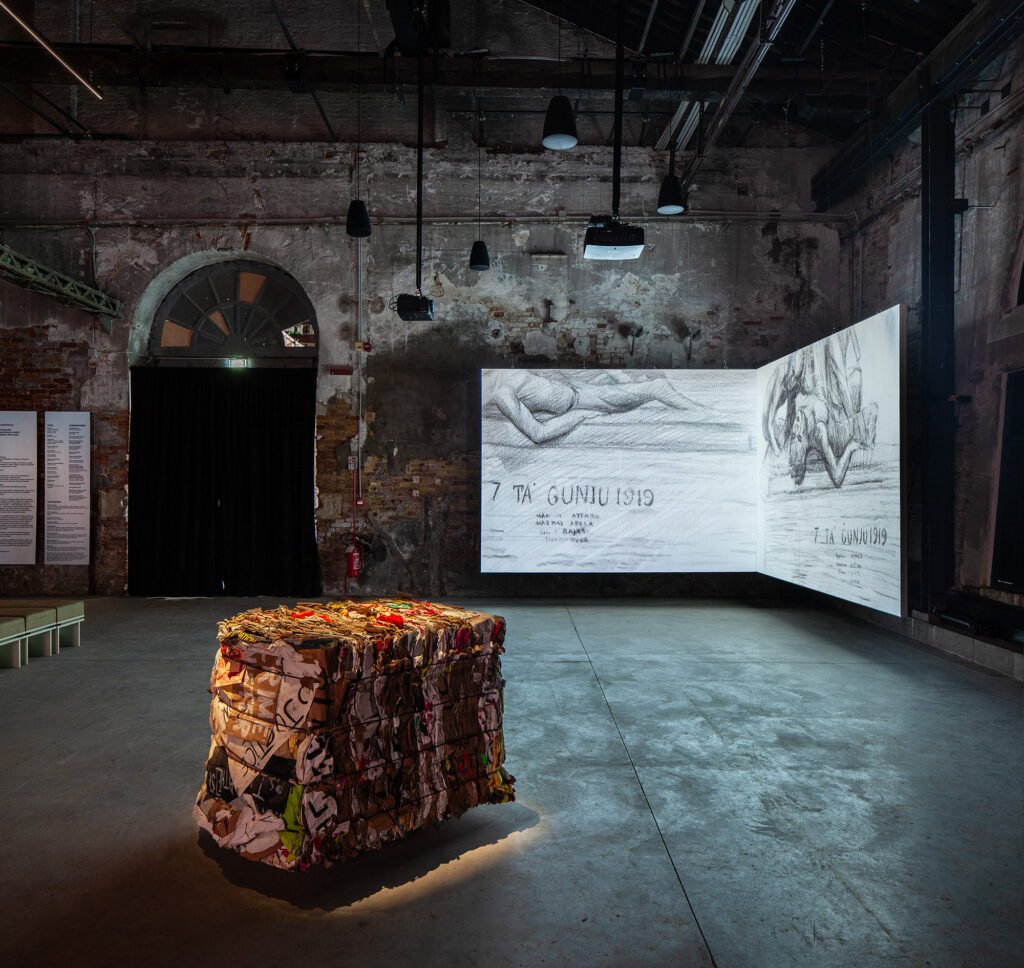
The dual-channel animation moves rapidly through the ‘Sette Giugno’ riots of 1919, church- and party-led demonstrations and protests of the late 1950s and early 1960s, anti-EU protests, pro-choice rallies, and more. Two bronze monuments in Valletta also make an appearance. At one end of the looping animation, details of the ‘Sette Giugno’ commemoration of those killed by British soldiers in 1919 emerge alongside archival imagery. At the other, the Great Siege monument, transformed into a shrine for the murdered journalist Daphne Caruana Galizia, appears in dialogue with the protests that followed her death. The inclusion of the two monuments places art in direct tension with the embodied presence of those who take to the streets. Yet the work stops short of suggesting whether either holds greater efficacy in the pursuit of social justice.
Facing the two projections lies an altar-like sculptural block made of thousands of reproduced and compressed protest posters and banners used in a variety of Maltese campaigns during the last few decades. Political desire materialises itself not as a heroic gesture but as the circulation of raw matter. In this anti-monument produced in the same baler facility in which machinery sounds were recorded, notions of progress and triumph dissolve into illegibility yet retain the potential for recycling.
Whoever prays for a revolution that will never come participates in a ritual performed in the absence of faith. The ritual seemingly reinforces group identity within a late-capitalist condition in which dissent is structurally integrated into the very system it challenges. The system appears open because people are free to march, yet they rally around a political terrain capable of absorbing its own critique by translating it into mere content.
In Vella’s work prayer appears as a by-product of language, an invocation of something through words, chants, slogans. The dual-channel structure presents short red phrases that appear to echo the declarative optimism of constitutional rights, yet are soon overridden by a sense of fatigue.
The classical proportions of the serif typeface simultaneously evoke printed legal and devotional texts, transforming the right-angled projection screens into a massive, suspended book.
Here, hope does not emerge from mourning a lost era of ‘authentic’ activism, but from the act of drawing itself. Beyond the thousandth image, what remains is a compulsion to continue, even alongside exhaustion and rupture. The quiet murmur of resistance persists within the restless movement of the image.
Sound design: Michael Quinton
Video editor and technical consultant: Niels Plotard
Studio assistants: Jake Attard, Marta Wróblewska
Thanks to
Michael Briguglio, Rafel Grima
Photos: Julian Vassallo and Samuele Cherubini